
Learning to See Differently: A New Chapter in My Artistic Journey
For the past few blog posts, I’ve been sharing my journey—this new quest I’m on—to find meaningful landscapes in Virginia and translate them into pen and ink art. I’ve always found a sense of peace and quiet joy in nature, but now I’m approaching it more intentionally, hoping to capture not just scenery, but feeling.
This week, and last, I spent a good deal of time online, researching places I might visit next. I've gathered a list of potential spots, but I’m realizing something: it’s not just about finding a beautiful place. I don’t want to make pictures of the typical views, the postcard versions everyone’s already seen. I want the scenes to feel more casual, like something you’d stumble upon during a quiet drive or an afternoon walk. I want them to invoke memories of pleasant travels, of moments when you weren’t posing in front of a landmark but simply living near it.
That feeling is hard to pin down.
I’ve come to understand that the way to create it might be by portraying these notable places as part of the broader landscape—less like a monument, more like a moment. That shift requires a kind of artistic license I haven’t quite mastered. I tend to be a very literal artist. If something’s in the reference photo, it tries really hard to show up in the final drawing. And that’s not artistic—it’s just copying.
I don’t love that I struggle with this. I know it’s rooted in my inexperience, and probably a little perfectionism too, but that doesn’t make it easier. I find myself wondering why I can’t just draw what I want to draw and let the rest go. There’s a freedom in that kind of expression that I deeply admire in other artists. I believe that if I keep working at it, I’ll get there.
This week, I made a step in that direction. I just finished my first “intentional” landscape: the McLean House in Appomattox Court House National Historical Park. It’s a beautiful old home surrounded by open land, outbuildings, and trees—a scene that holds weight because of its place in history, but also quiet beauty in its own right. I loved the photo I took of it, but the image also included an awkward fence beside the walk leading up to the house.
The fence was a problem.
It turns out that part of the fence isn’t original to the house—it was added during restoration, and while that’s historically interesting, it wasn’t aesthetically helpful. It distracted from the peaceful, timeless quality I was trying to capture. And so, I took it out.
You’d think that would be a small thing. It wasn’t.
Removing that fence took an absurd amount of inner debate. It felt like I was betraying the reference photo, like I had no right to alter reality. But I reminded myself—this is art, not documentation. And so, after much hesitation, I erased it from the composition. Ouch. It was hard. But I did it.
That one decision made me realize how tightly I hold to visual “truth,” and how often that’s at odds with what I’m actually trying to express. I didn’t need to show the fence. What I needed to show was the feeling of that day, that place, that quiet piece of Virginia history.
Another challenge I faced with the McLean House piece was detail. My artwork is extremely detailed, whether I want it to be or not. I sit down intending to draw loose suggestions of things—and five hours later I’ve lovingly inked ten thousand tiny leaves. Okay, maybe not ten thousand, but that’s what it feels like. And once you commit to that level of detail in one part of the drawing, the rest has to match. Or you start over.
This is something I want to change. I want to learn how to draw suggestion—how to let the eye fill in the blanks. But right now, it’s like my hand doesn’t listen. I see everything, so I draw everything. I suppose that’s still part of my voice as an artist. Maybe someday I’ll be able to temper it. For now, it’s just where I am.
Once I finished the piece—fence removed, detail battle fought—it came time to sign it.
Let’s talk about signatures.
You’d think signing your own name would be easy. It’s your name, after all. But no. My regular signature, the one I use for checks and forms, doesn’t feel right for my artwork. I’ve been using my initials, inside a little box, and I like that. But this time, I forgot to leave space for it in the drawing. So I had to sign outside the image, and that made me feel like I needed to write my full name.
But now it’s a professional signature. And of course, it needs to be legible. Maybe someday my work will be in a museum, and I want whoever finds it in a dusty archive to know it’s mine. So I carefully penciled in my name… then promptly ignored the pencil lines when I inked it. Classic. And the result? Not my best. Fudge nuggets!
At least the title came out okay. Small victories.
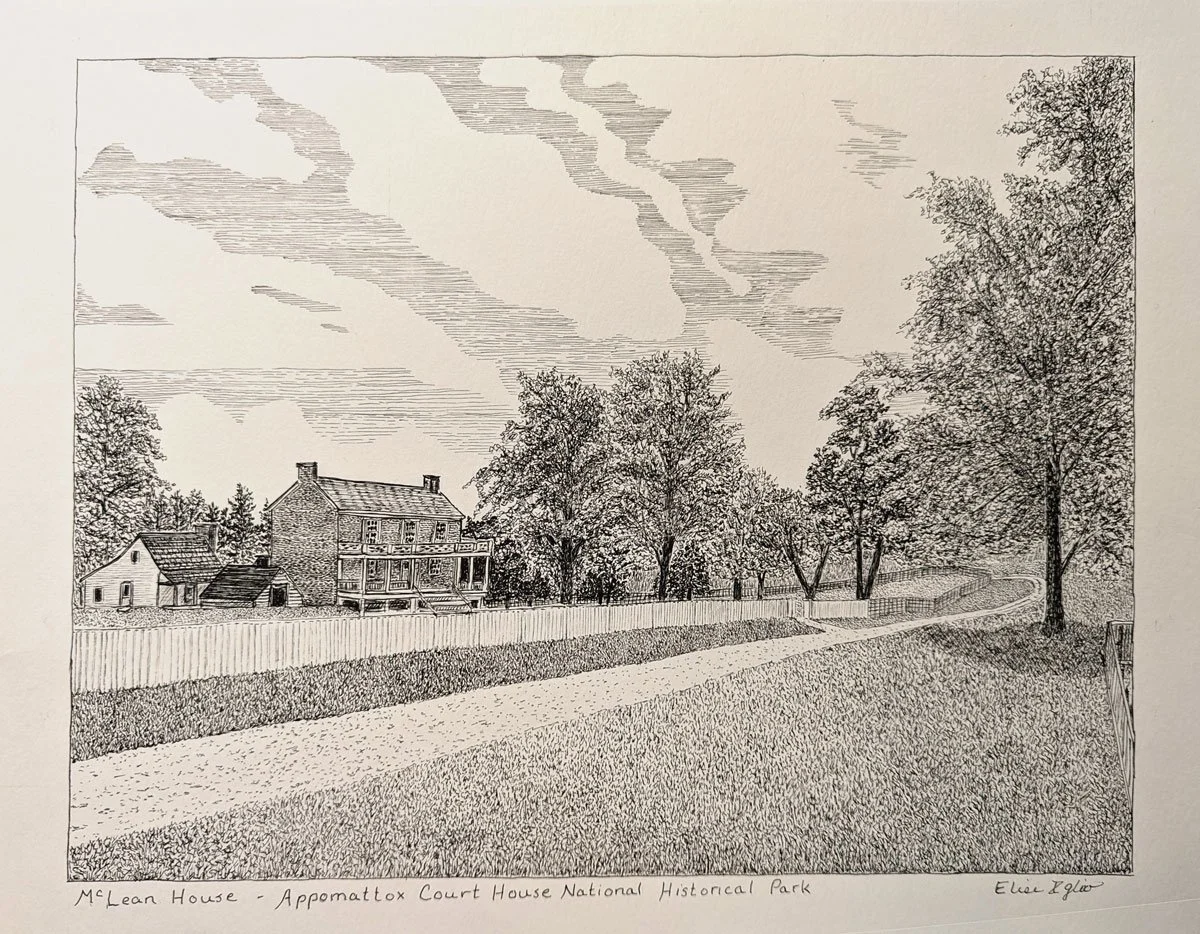
Taken with my phone. I need to do a professional scan to make prints…
All in all, the McLean House drawing is fine. It’s not what I hoped it would be, but it’s not bad either. It’s a start. I know I’m my own worst critic, and that every artist wrestles with that voice. But it’s hard to tell if something I’ve made is objectively good—or just something I tried really hard on. So I’ll do what artists do. I’ll send it out into the world and let it speak for itself.
I’d love to know—do other artists go through this? The second-guessing, the struggle with simplifying, the signing fiascos? Or is it just me and my picky pencil-hating hand?
I know this much: the next drawing will come easier. Or maybe it won’t. But either way, I’ll keep going. One fence removed, one shaky signature at a time.