
A Cloudy Decision: Lessons in the Sky
In my last blog post, I talked about trying to decide whether I should continue on my artistic journey with pen and ink, or pen and wash, or both. A few people kindly weighed in, suggesting I do both in order to serve a broader audience. It’s solid advice—and twenty years ago, I probably would have taken it.
At this point, though, I know myself a little better. Doing both would mean not only continuing to deepen my skill in ink, but also significantly leveling up my watercolor technique. I’m working hard to grow in pen, and—truthfully—that’s where my heart is. Could I improve my watercolor? Sure. But after finishing a pen and wash piece to see how it felt, I realized: I just don’t enjoy it enough to put that much time into it..
I was already leaning toward choosing only ink, but my most honest critic (blunt, but fair) confirmed it. He said the watercolor piece looked amateurish next to the pen drawing. And he’s right. Pen and wash can be a wonderful style, and I do like the look—but it’s a style that tends to be much simpler. The linework is minimal. That’s why it is more easily found online, it’s popular with beginners, but that’s not the work I want to produce. I don’t want to finish a piece and feel like it was easy. I want to feel like I worked hard and infused part of myself into it.
I know that probably sounds a little silly. But I also think it’s silly to dedicate myself to developing a skill purely because it might appeal to a wider audience. That’s what I was doing back when I was making products to sell, instead of making art. I’m done with that.
Yes, of course, my work needs to resonate with people in order for it to be seen, loved, and purchased. But I also have to be happy with the effort I’m putting in and with what I create. Otherwise, what’s the point? I can’t expect others to connect with the art if I’m not connected myself.
So that’s the decision, folks: I’m continuing with only pen. And once I decided that, it felt like a weight had been lifted. I could just get on with it.
My next piece was already on the drawing board, patiently waiting for ink. I’m happy to report that I managed to ink it without ruining it—always a small victory. And yes, it’s full of detail. This time, though, I think the detail is in the right places. I decided to stop apologizing for how much I love small details and just let myself revel in them. I drew leaves to my heart’s content.
I’m getting better at suggestion rather than slavish accuracy—but let’s be honest, there’s still a lot of ink on the page.
With the “heavy” part of the drawing done, I was left with the sky. Over half of the reference photo is clouds. I saved them for last. Why? Because I had absolutely no idea how to render clouds. None at all.
So why did I choose a reference with so much cloud area? Because I liked it, of course! Clouds are gorgeous. And I didn’t want to ruin them.
For once, I didn’t charge ahead. I’m really trying to go slow, to be thoughtful and deliberate about what I put on the paper. When I first started drawing, I did the best I could at the time and called it good. But now I know my “best” can be better—if I practice, and if I take my time. There’s no sense in spending five hours drawing leaves and then getting sloppy or impatient with the part I’m unsure about.
So let’s talk about clouds.
The clouds in my reference were dark and rather featureless—just a soft, gray backdrop. They weren’t especially interesting, but still, I was determined to draw them just as they were. Because if you’ve been reading for a while, you know that I’m rather addicted to visual truth. Leaving something out or changing it feels like cheating. So I practiced. A lot. I filled sketchbook pages trying to replicate those murky clouds.
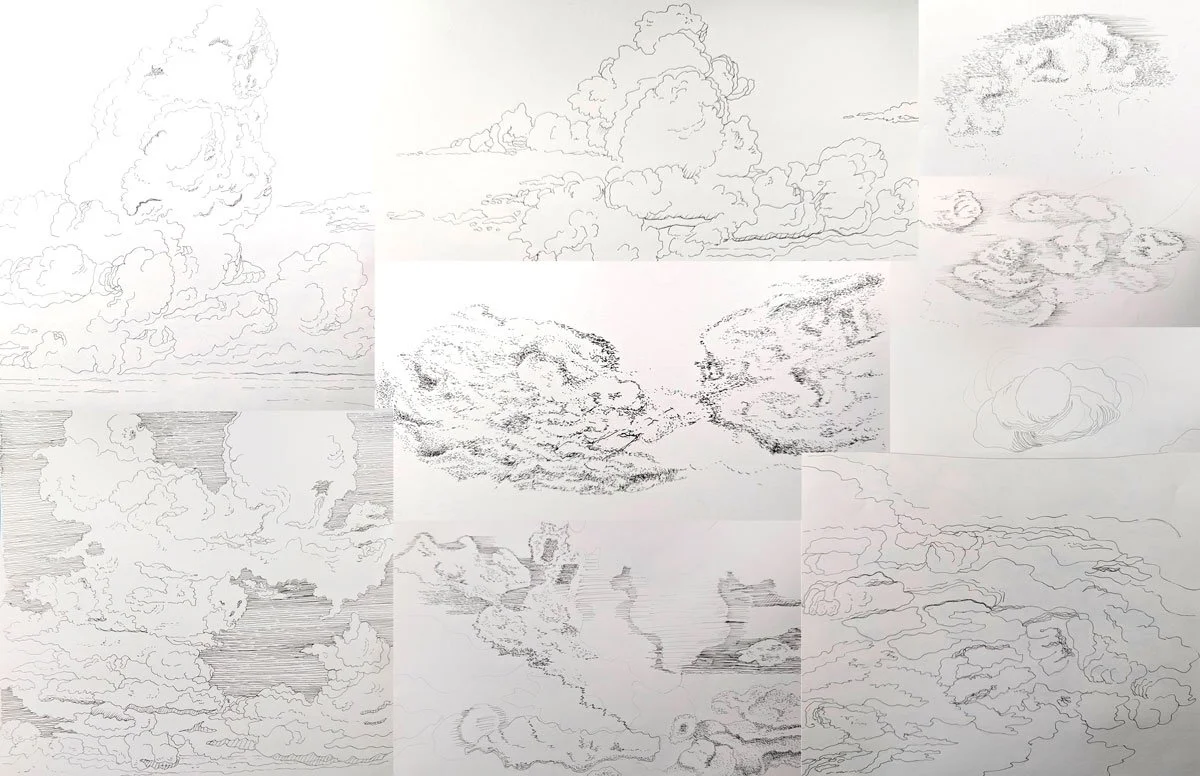
Here are some of my practice pages. So many clouds!
I also looked up how other pen artists render clouds. Most of the ones I found didn’t appeal to me. Franklin Booth is one of my favorite illustrators, and he does magnificent clouds. Too magnificent for me or my style of drawing.
I scrolled through hundreds of ink drawings of clouds. I watched tutorials. And almost every cloud image I liked turned out to be done in pencil. Which, of course, makes sense—clouds are soft, and pencil draws soft lines. A match made in heaven. I draw in ink. Not so heavenly. (No pun intended.)
I kept practicing, copying bits of others’ cloud drawings just enough to get a feel for the shapes and movements. I don’t like copying, but I’ll do it in studies if it helps me understand something. I discovered that my hand has strong opinions about what shapes it wants to make. Round, lumpy cloud shapes? Not its favorite. Still, I persisted.
Eventually, I managed a sketchbook page of clouds I didn’t hate. That was enough. I lightly penciled in some cloud forms on my actual drawing, which made things feel less terrifying. It only got scary once I picked up the pen. (If you remember, my hand also doesn’t enjoy following pencil lines. It has a mind of its own.)
But I finished it. And not only was I thrilled to be done—I was proud. I had worked hard on this one, especially the part I didn’t know how to do. I took the time to practice. I took my time with the final piece. And most shocking of all: I ended up drawing clouds that don’t appear in the original photo. I didn’t agonize over the change. I didn’t even argue with myself for too long.
That, my friends, is progress. And I’ll take it.