
“I Know That Place”: A New Quest for Meaningful Landscapes
Last week, I embarked on a new artistic quest—a search for landscapes that would not only inspire me but might also stir something meaningful in those who see my work. At first glance, it sounds simple enough: find something beautiful in nature, capture it, and translate it into pen and ink. But as with so many creative paths, this one quickly revealed itself to be more complex, more layered… and ultimately, more rewarding.
I’ve always been drawn to portraying nature. It offers an endless well of inspiration—shapes, patterns, quiet dramas unfolding in plain sight. But beyond that, I find nature to be deeply healing. There’s something about it that re-centers me, that reminds me I am part of something vast and sacred. Nature speaks the language of the spirit, and I’ve long tried to echo that language in my art. I also believe nature hints at a greater life force—a divine thread that connects all living beings. That, more than anything, is what I hope to share.
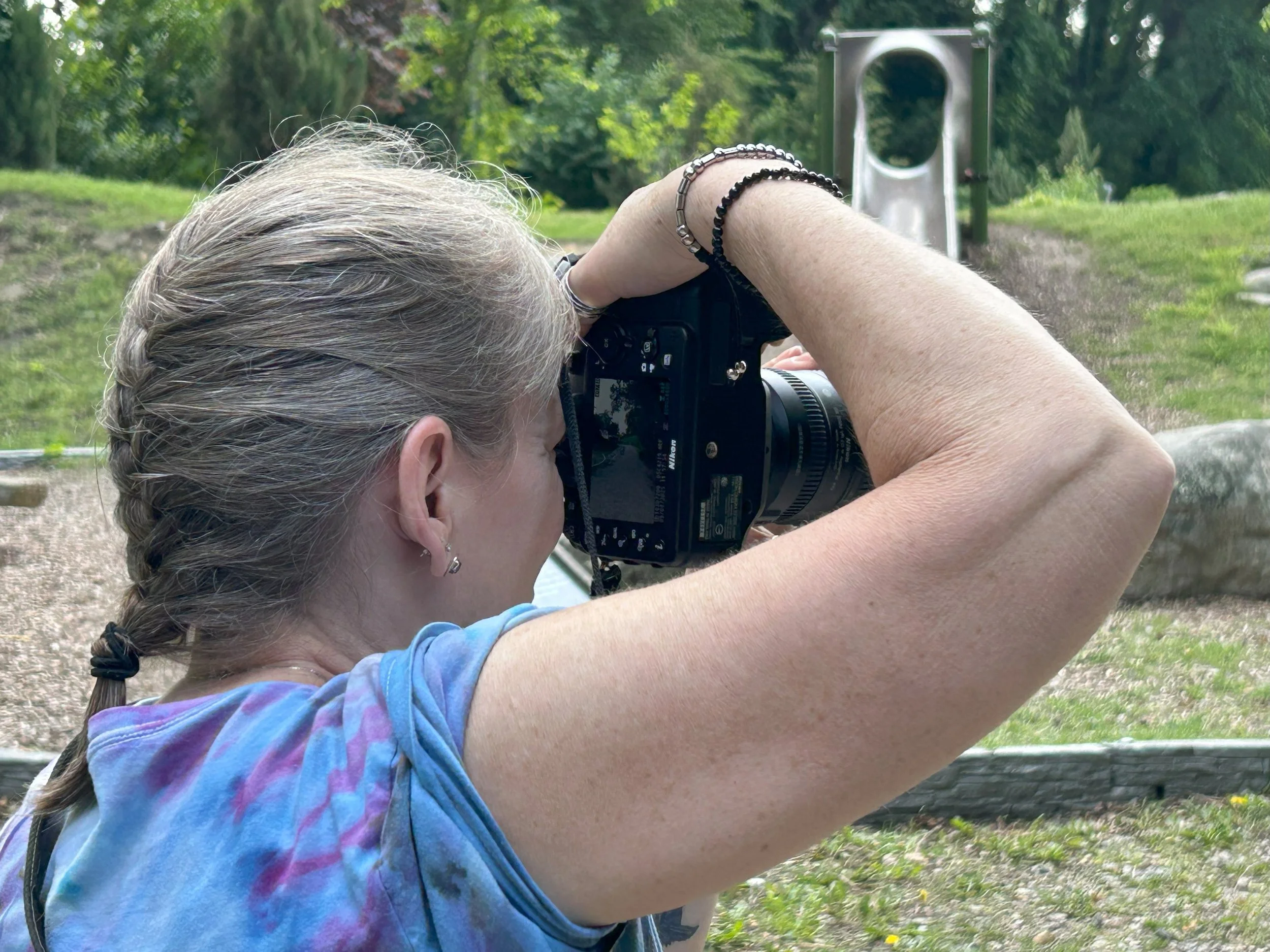
So, with my trusty camera in hand and my ever-faithful companion Charlene at my side, we headed out to begin this journey. Our first destination was the Appomattox River, chosen for its proximity and accessibility. The day was clear and bright, and the river shimmered with sunlight. I focused my lens on shoreline vegetation, graceful water birds soaring above the current, and the distant line of trees on the far bank. It was all so beautiful—breathtaking, even—and through the lens, everything seemed promising and alive.
I couldn’t wait to return to the studio and sort through the photos. But once I sat down and began reviewing them, I felt... underwhelmed. Not disappointed, exactly, but deflated. The images weren’t bad—they were well-composed, sharp, and captured the atmosphere of the place. But they didn’t speak. They were, in the end, just pictures. Nothing about them stirred emotion or invited a story. Even the birds—majestic and beloved as they are—felt strangely generic in this context. I could admire them, but I didn’t feel them.
And that realization led me to ask: What was it about the two landscapes I’ve already drawn that made me want to create more in the first place?
One of those earlier pieces was pure fantasy: a forest path illuminated by glowing lanterns, with an endearing little snail perched on a toadstool, showing the way. I love the whimsy in that piece, the sense of wonder. But I also know it came from a specific imaginative impulse, and I don’t feel the need to repeat it. It was a one-time vision that doesn’t quite translate to a series.
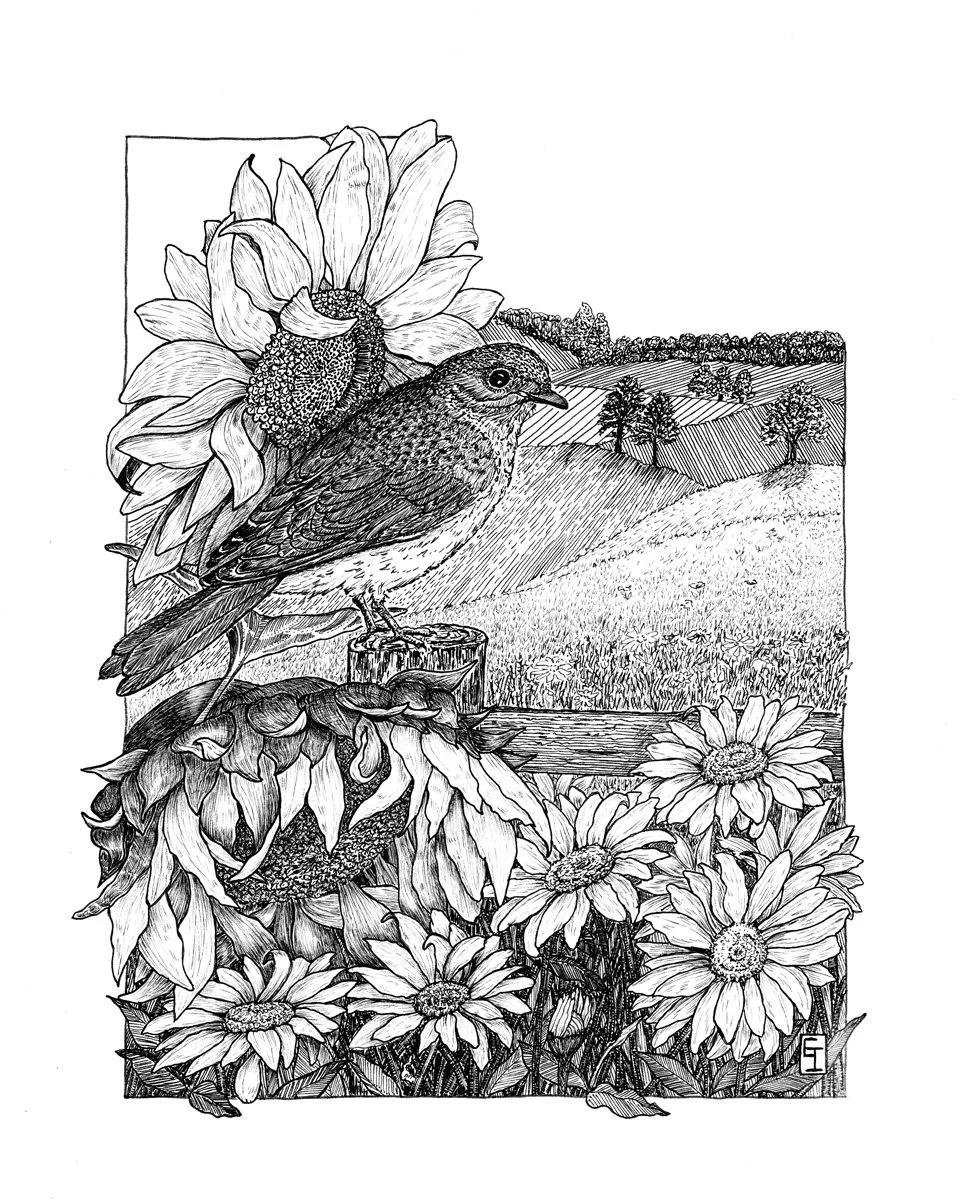
The other landscape, though—that one has stayed with me. It’s a bluebird perched on a rustic fence, framed by sunflowers, with soft, rolling hills stretching into the distance. That one is grounded in memory. I created it after a trip to visit my daughter in Pennsylvania several years ago. The scenery we passed through was absolutely enchanting—gentle farmland, waving fields, wildflowers by the roadside. It etched itself into my heart.
The piece, titled Virginia Road Trips, holds deep personal meaning for me. But what’s been even more meaningful is how others have responded to it. Charlene, for instance, immediately connected with it—she’s traveled through the western parts of the state, and it sparked her own recollections. When the piece was displayed in the Library of Virginia for a juried show, most of the comments I received centered on the fine detail, and the recognizable, memory-laced qualities of the image.
“I think that’s a bluebird—those are my favorite!”
“That looks just like ____ County!”
“Those hills—I know those hills.”
And that’s when it clicked for me. It wasn’t just the technical composition or even the nostalgic charm of a bluebird on a fence. It was the recognizability. People saw a reflection of their own story in the image. The landscape was familiar. They could envision themselves standing in it, remembering a place they’d been, or a feeling they once had.
That, I think, is the missing piece in the river photos. Yes, many of us have walked by a riverbank in Virginia, but without a specific anchor—something that places the scene firmly in a recognizable context—the image floats, untethered. There’s no foothold for the viewer’s imagination or memory.
So this has shifted my quest in a very particular and exciting way. I now believe that the key is to focus on places in Virginia that carry emotional or historical weight—natural landmarks, rural nooks, small-town vistas, or even modest man-made structures that quietly define a place. Places that invite the viewer to say, “I’ve been there,” or better yet, “I remember that.”
Virginia offers an abundance of such locations. Our landscape is astonishingly varied, ranging from the gentle swells of the Piedmont to the wild beauty of the Blue Ridge, from the Atlantic coast to hidden coves along winding rivers. Add in the state’s historical richness, and it becomes clear there’s no shortage of inspiration here. I’ve begun researching locations to visit—some well-known, others more obscure—and I’ve found that while there are countless photographs of Virginia, there are surprisingly few interpretations in pen and ink. That opens a door.
As an artist, I’m always balancing the desire to create something original with the reality of what resonates. I don’t want to compete in an oversaturated market, nor do I want to carve out something so niche that no one connects with it. But I think pen and ink landscapes of Virginia—infused with nature and emotion—might strike that rare chord between freshness and familiarity.
And nature will always be central to my work. I need it to be. It’s more than an aesthetic choice—it’s my way of offering something restorative. My hope is that by combining nature with specific, memory-rich places, I can create art that not only pleases the eye but also touches the heart.
So, the quest continues. But now, it’s guided by a clearer purpose: to seek out those places in Virginia that quietly call out to us—places with stories and stillness, history and hope. I’ll be taking reference photos, visiting tucked-away corners, and yes, even practicing my architectural drawing skills (because some buildings may need to make an appearance). Just enough for someone to stop and say, “I know that place.”
And when that happens, when someone feels seen or remembered because of a piece I’ve drawn—that’s when I’ll know I’ve found what I was truly looking for all along.